

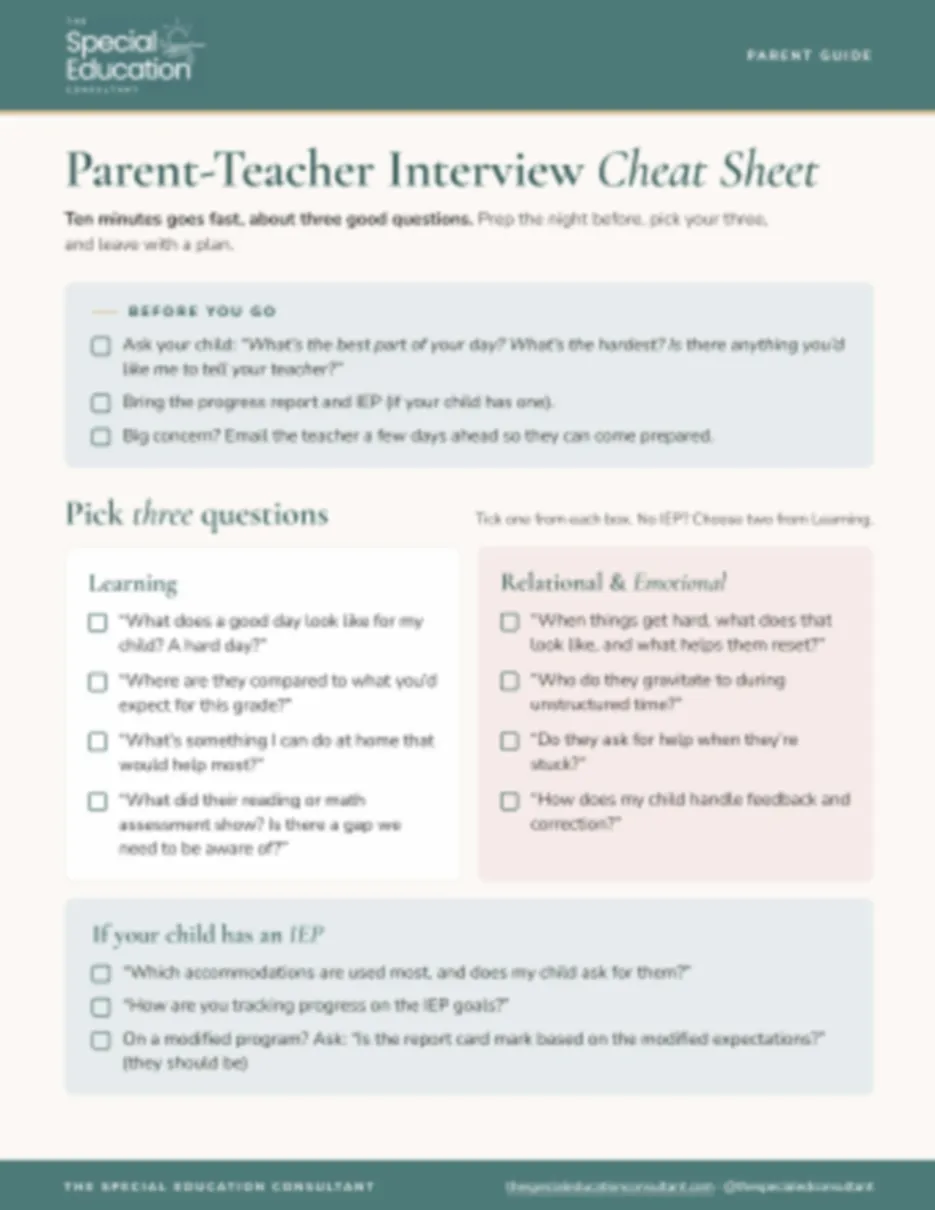
Ten minutes goes fast. About three good questions.
A two-page printable from Talia Kniznik, Ontario Certified Teacher and Special Education Specialist. Prep the night before, pick your three, and leave with a plan. Enter your email and we will send you a copy, and you can download it right away.
Before you go
- Ask your child: “What’s the best part of your day? What’s the hardest? Is there anything you’d like me to tell your teacher?”
- Bring the progress report and IEP (if your child has one).
- Big concern? Email the teacher a few days ahead so they can come prepared.
Pick three questions
The cheat sheet splits the best questions into three groups. Pick one from each. Here is a taste of each group.
Learning
- “What does a good day look like for my child? A hard day?”
Relational and emotional
- “When things get hard, what does that look like, and what helps them reset?”
If your child has an IEP
- “Which accommodations are used most, and does my child ask for them?”
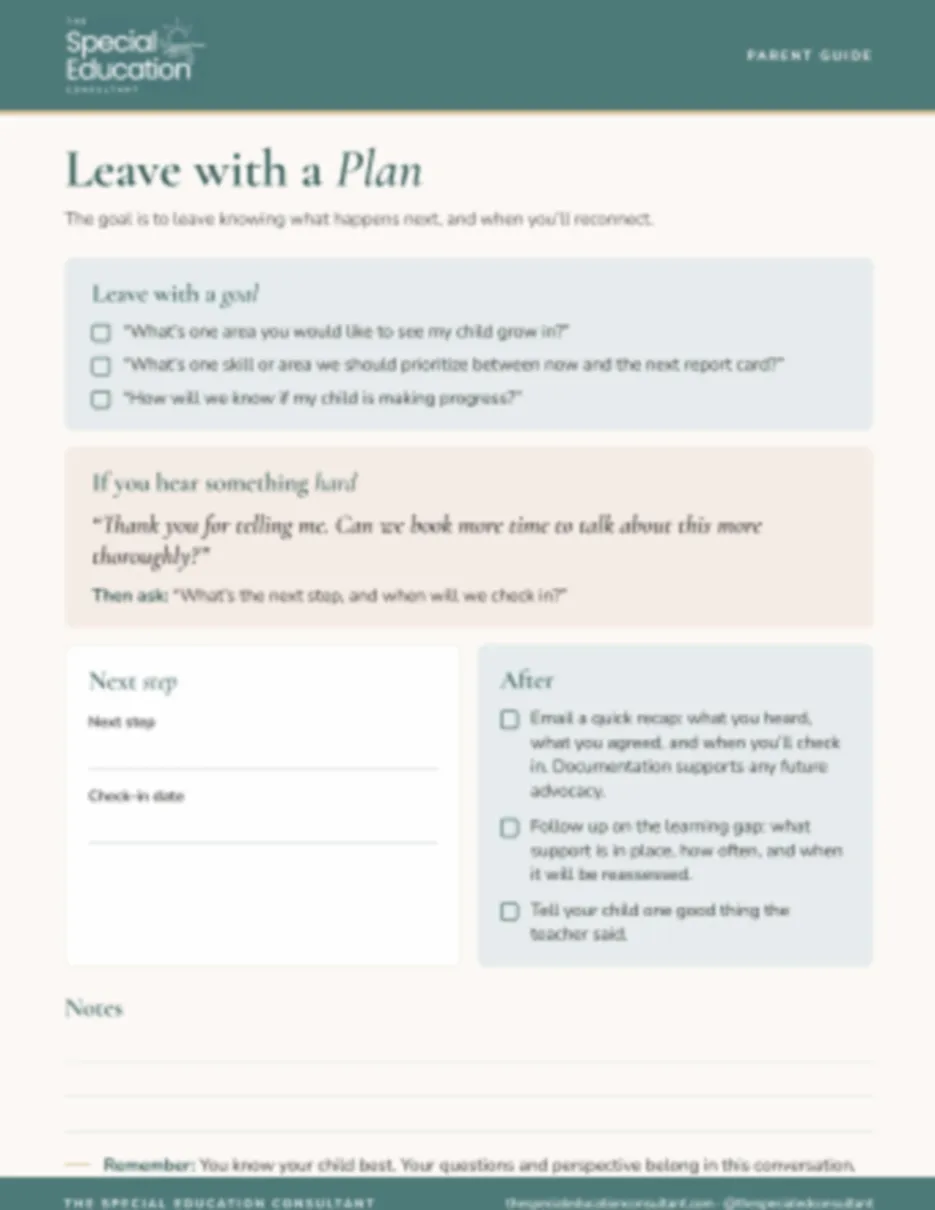
Get the full list of questions, plus page two: goal questions, the exact words to use if you hear something hard, a next-step box and what to do after the interview.
Going deeper on IEPs? Read questions to ask at an IEP meeting and how modified marks work on the report card.
Remember: you know your child best. Your questions and perspective belong in this conversation.
Frequently asked questions
How many questions should I ask at a parent-teacher interview?
About three. Most interviews run around ten minutes, so three good questions leave time for the teacher's answers and for agreeing on a next step. Pick one about learning, one about how your child is doing socially and emotionally, and one about the IEP if your child has one.
What should I bring to a parent-teacher interview?
Bring the progress report and, if your child has one, the IEP. If you have a big concern, email the teacher a few days ahead so they can come prepared, and ask your child beforehand what the best and hardest parts of their day are.
What if I hear something hard at the interview?
Stay calm and do not try to solve it in ten minutes. Ask for a longer follow-up meeting and agree on a next step before you leave. The cheat sheet gives you the exact words to use.
What should I do after the interview?
Put what you heard and agreed in writing, and follow up on anything that needs support. Page two of the cheat sheet has a short after-the-interview checklist.
What should I ask if my child has an IEP?
Ask which accommodations are actually used in class and how progress on the IEP goals is being tracked. The cheat sheet has three IEP questions, including one that catches a common report card mistake on modified programs.
Heard something that worried you?
If the interview raised a concern about learning, an IEP or an assessment, a free discovery call is a good next step. Bring your notes.
Book a free call